Inner ear interest draws woman to audiology | Local Business - Fairbanks Daily News-Miner
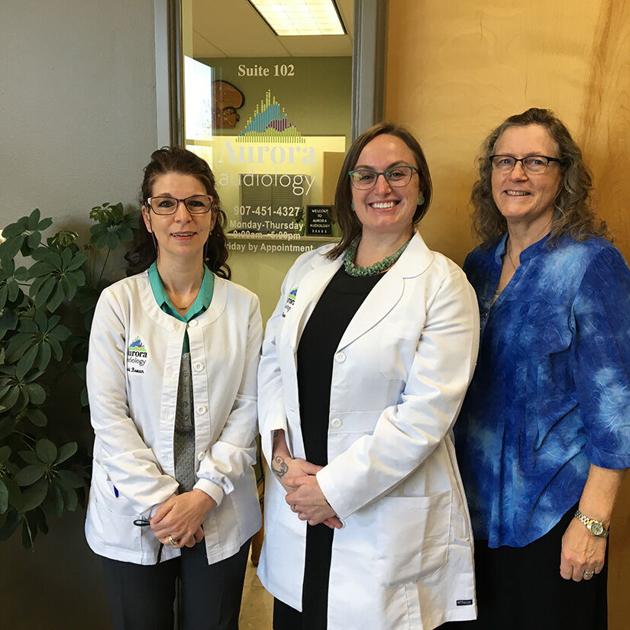
There are many reasons a person can suffer hearing loss. Exposure to high-decibel noise from loud rock music, heavy equipment, gunshots or even jet engines are common causes, but ear infections, auditory nerve tumors and other issues can also be the culprit. While hearing aids can go a long way toward restoring a person’s hearing, the diagnosis and treatment of the underlying cause is an important but often overlooked part of the process. Lily V. Hughes, a board-certified audiologist, aims to bridge that gap.
Originally from Vermont, Hughes earned her doctor of audiology degree at the West Virginia University and has worked in the field for 10 years, five of those in Fairbanks. Hughes purchased Northland Hearing Services this summer, changed the name to Aurora Audiology and moved the business to its new location at 1901 Airport Way.
During a Thursday morning interview at her new offices, Hughes enthusiastically explained what she does and why it’s important.
“I knew I wanted to be in some type of medical profession due to watching my grandfather struggle through a rare neurological disorder. I initially thought about neurology and neurosurgery, but as I learned about various options in undergrad, I fell in love with the inner ear balance system. Vertigo, balance and concussions became an interest,” Hughes said. “I then learned about cochlear implants, the ear and just how complex the entire auditory system was. Then ... boom, audiology! I can’t tell you how much my profession excites me, especially being able to help this community.”
After Northland Hearing’s owner, Maria Clark, passed away in February, clinic employees Debbi Brown, a hearing aid dealer, and Leslie Greenfield, a patient care coordinator, kept the business open to make sure customers had access to the services they needed. Brown and Greenfield stayed on after Hughes purchased the business and are instrumental in helping Hughes to provide comprehensive audiological care to current and new patients.
“While Northland Hearing Services helped many people over the past 20 years, the focus was on hearing aid retail, which is not always a comfortable experience. Our goal as we find our groove in this community is to provide diagnostic hearing evaluations and exceptional hearing loss treatment through comfortable, patient-centered care. Hearing loss does not have to be a stigma or joke among friends and family, but something we all will experience and can manage with the appropriate testing and treatment options,” Hughes said.
Though Hughes has a doctorate in audiology, she is not a medical doctor and cannot treat serious ear ailments.
“I’m like a nurse practitioner — I’m somebody that can help a person a lot, but I don’t have the ability to do surgery. I’m trained to present a variety of treatment options to patients with hearing impairment, including hearing aids and to work closely with providers in the community to make sure that medical and surgical treatment is available. So I’m like an optometrist. You have a scope (of knowledge) and can do so much for people, but you have to know when it’s beyond your scope and they need someone else’s help. Then I would refer them to an ENT,” Hughes said, referring to otolaryngologists, more commonly known as ear, nose and throat doctors.
Hughes said she and her staff are focused on helping their patients make educated decisions about hearing loss so they can get back to doing the activities they enjoy. To do that, they administer several types of tests to determine the location of the problem and its effect on a patient’s hearing.
“It begins with video otoscopy. You start on the outside to examine the ear, looking for infection and wax build up or foreign objects. Wax is a good thing, and rarely is it an issue in hearing loss. It’s there to protect your ear and it’s a natural mechanism of cleaning it,” Hughes said.
Once she ensures the problem isn’t caused by blockage, Hughes moves on to the middle ear, where the eardrum and earbones — the hammer, the anvil and the stirrup — are located.
“We do, essentially, a pressure test to confirm that the structure is functioning like it should. We vibrate the eardrum and make sure the bone structure is intact. That is another part of the ear that can have problems, and if it does, then we do a referral.”
Problems with the inner ear are diagnosed with pure tone testing, which involves having the patient listen to a wide range of sounds through a pair of headphones.
“We’re talking everything from a whisper to a 120 decibels, which is about the level of a chainsaw or a gunshot. The pure tone testing allows me to separate out the ear with air and bone conduction,” Hughes said.
Speech testing is the final component of testing.
“We look at how your brain interprets the sensory stimulation, and that might give us an idea of how the sensory loss is affecting you neurally. Because ultimately, hearing begins with the ear but is perceived and used by our brain,” Hughes said. “We have the patient repeat words, and I’m calculating a level, very quiet, to find out what is clear to them without context or visual cues. That shows the breakdown in the brain, which is really what we’re treating with hearing aids. Ultimately, the rehabilitation is in teaching the brain about sound again.”
Contact staff writer Dorothy Chomicz at 459-7582. Follow her on Twitter: @FDNMcrime.


Comments
Post a Comment